
Report
💡 Active projects and challenges as of 14.10.2026 19:26.
Hide text CSV Data Package Print
ZHAW Social Work
FundingNavigator
Smart Matching for Social Funding in Switzerland
Challenge statement
The problem: A social worker in Zurich has a client in crisis. She opens a 120-page PDF, scrolls through 180 foundations, guesses which one might fit — and waits 3 months for a rejection. Wrong target group. Start over.
Foundations are drowning in mismatched applications. People in need are drowning in waiting time.
The solution: FundingNavigator asks 3 simple questions — Who are you? What do you need? How urgent is it? — and returns a ranked list of matching funding sources in seconds. Not just foundations: also crowdfunding, sharing economy, and public programs. One search, the full funding mix.
How it works — 4 real scenarios
- 🔴 Case 1: Single mother, urgent dental bill (CHF 3,200) The system filters for foundations with rolling decisions (2–3 weeks), matches her profile as a Swiss citizen and single parent, and suggests a crowdfunding campaign for the remaining gap. Time saved: weeks.
- 🟡 Case 2: Social worker needs education funding for a young refugee The client has permit B and partial scholarship funding. FundingNavigator filters out foundations that exclude non-Swiss applicants, finds those that explicitly welcome migrants, and flags that a supplementary scholarship request is possible. No more blind applications.
- 🟢 Case 3: NGO seeking CHF 25,000 for a mentoring project The system builds a blended funding plan: foundation grant + crowdfunding + municipal integration credit. It checks submission deadlines against the project timeline. Strategic, not random.
- 🟠 Case 4: Refugee family needs furniture + deposit for their first apartment FundingNavigator goes beyond cash: it finds free furniture on sharing platforms within 15km, connects to a Brockenhaus starter kit program, AND matches two foundations for the financial gap. The full spectrum.
What we build at the hackathon
- Structured dataset — 180 foundations extracted from the ZHAW PDF into searchable JSON
- Guided questionnaire — 3-step needs assessment
- RAG-based matching engine — ranked results with match scores
- Urgency filter — because when you're in crisis, 3 months vs. 3 weeks changes everything
Impact
Fewer rejected applications. Faster help for people in crisis. Less admin burden on foundations. And an architecture that scales to all 26 cantons.
Let's turn a PDF into a lifeline. 🧭
- See also: Challenge slides (PDF)
- Data source: https://www.zhaw.ch/de/sozialearbeit/zuerich-sozial#c219512
Swiss Refugee Council
AI-assisted categorization and summarization of court rulings
The Swiss Refugee Council advocates for the protection and rights of refugees. If an asylum application is rejected by the Swiss authorities, the asylum seeker can appeal against the decision at the Federal Administrative Court. The court’s decisions are published in a publicly available database — essentially a collection of PDFs with some metadata. The Swiss Refugee Council identifies, categorizes and summarizes the relevant decisions to create an overview that assists legal representatives in their work.
Currently, this overview is created manually. This is time-consuming because the court publishes around 100 decisions each week.The aim of this challenge is to develop an AI-based tool to automate this process. This tool would extract useful information such as the number of judges involved in the ruling, the asylum seeker's country of origin, and the outcome of the decision using LLMs or other ML models. In addition, the tool should create a summary of the court ruling that will help lawyers to quickly understand the essentials of a case.
Caritas Switzerland
AI-Powered Social Storytelling for Donation Campaigns
More than every sixth person in Switzerland lives at risk of poverty. Yet the issue remains invisible and taboo. Caritas reaches its existing, loyal donor base - but struggles to connect with younger, digitally native audiences who spend their time on Instagram, TikTok and Facebook. Traditional fundraising campaigns are expensive to produce, require professional copywriters, designers and translators, and often fail to reach with new audiences.
In today's environment - rising cost of living, social media fatigue, short attention spans - Caritas needs fresh, authentic and scalable ways to tell the stories of people in poverty and inspire donations. Behind every counseling session is a human story: a single mother who cannot afford heating, an elderly man choosing between food and medication. These are true stories - and when told well, they inspire donations. But producing multi-language, platform-native content (e.g., Instagram carousels or TikTok videos) requires resources most NGOs lack. Caritas needs a smarter way to bring these stories to the people who have never heard them. An AI-powered solution could close this gap - turning a single-story prompt into a campaign in minutes.
Goal:
- (1) An AI application that takes a true, anonymized story of someone living in poverty in Switzerland as input and generates a ready-to-publish, donation-inspiring social media campaign.
- (2) The system produce at least one of the following: a short video ready to post on Instagram, TikTok or Facebook, or an Instagram carousel.
- (3) Creative direction is open: for example, a comic strip depicting a day in someone's life can be delivered as swipeable carousel panels or as a short animated video.
- (4) The output always includes a clear donation call-to-action, a platform-native caption, and relevant hashtags. Content must be generated in at least one of the following: German, French, Italian or English. (5) The solution should be fast, ethical, usable by non-technical Caritas staff.
More details and resources in: https://github.com/Caritas-Schweiz/H4SG_Donation_Campaigns
City of Biel/Bienne
Community in a Box
Thousands of urban book boxes, sharing shelves, and swap corners exist across our cities, built by citizens, for citizens, with no budget and no coordination. Yet each one is an island. Nobody knows what's inside, who maintains them, or what's happening nearby.Community in a Box connects these objects into a living neighborhood network. Scan a box, find a book, discover a local event, offer a skill, meet a neighbor. No app, no platform, no friction. Just a sticker, a code, and the street around you.The first step toward cities that can see and strengthen what their citizens have already built.
Community in a Box
The Problem: Islands of Generosity
Our cities are full of quiet sharing: book boxes, community fridges, swap corners, built and maintained by citizens with no funding and no coordination. But each one is an island. A fridge needs supplies. Volunteers are needed two streets away. Nobody hears about it. These connections don't happen not because people don't care, but because they're invisible.
The Solution: Connecting the Neighborhood
We aren't here to build another platform; we are here to connect communities. We're connecting what already exists.
One small sticker turns any community object into a digital gateway for the neighborhood. Zero friction. No app. No account. Just scan and instantly:
- See what the box currently propose
- Find local events, repair sessions, and volunteer needs
- Exchange services and post announcements
- Discover other nearby sharing points
Our Hackathon Plan
During the hackathon, we will turn this vision into a prototype by:
- Understand and map the ecosystem: locate existing sharing points using existing data and crowdsourced insights
- Build the bridge: design a lightweight web interface and a visual identity for the stickers
- Prototype the experience: test how citizens scan, contribute, and discover in the real world
The Impact
Isolated boxes become entry points to a distributed neighborhood network. Neighbors find each other. Waste is reduced. Social ties strengthen. And it all grows organically, one sticker at a time.
Let’s turn isolated boxes into a thriving, distributed neighborhood network.
HEKS
Digital Asylum Glossary
The existing HEKS Asylum Guide, which is currently sold as a printed booklet, is also to be made available in digital form. The Asylum Guide provides a concise and accessible overview of the Swiss asylum system and is used by, amongst others, advice centres, students and public authorities.A digital version will allow for access at any time, with searchable and user-friendly functionality. Furthermore, updates resulting from legislative changes can be implemented more quickly, ensuring that the content remains up to date at all times. The aim is to simplify access to knowledge in the field of asylum and to make the work of users easier.
Challenge description (PDF)
Digital Asylum Glossary von Zoe StollChallenge idea: 4DJ8CXQP.pdf
Coup d'Pouce (Fondation Emploi Solidarité)
L'IA comme facilitateur de réinsertion et non comme risque
Développer un outil IA permettant d'élaborer du matériel pédagogique, l'automatisation des procédures administratives et permettant de surmonter les difficultés linguistiques pour favoriser la réinsertion socioprofessionnelle.
Mettre en place un concept et des outils qui permettent à une équipe de travailleurs sociaux de développer du matériel pédagogique audiovisuel adapté aux personnes peu formées afin de renforcer leur qualification professionnelle. Créer un outil permettant d’automatiser certaines procédures administratives, permettant aux travailleurs sociaux d’accorder plus de temps à l’accompagnement individuel et social. Identifier des outils d'IA permettant de surmonter les obstacles linguistiques ou liés à un handicap afin de favoriser la réinsertion et la vie quotidienne.
Develop a framework and tools that enable a team of social workers to create audiovisual educational materials tailored to people with limited training, with a view to enhancing their professional skills. Create a tool to automate certain administrative procedures, enabling social workers to devote more time to individual and social support. Identify AI tools to overcome language or disability-related barriers in order to facilitate reintegration and daily life.
Artificial Intelligence as a facilitator of reintegration, not a risk
Introduction: The Emploi Solidarité Foundation is active in the field of social and professional reintegration and the circular economy through its Coup d’Pouce shops. On the one hand, the people of Fribourg donate various items to us, such as furniture or clothing, which we refurbish in our various workshops before selling them in our four second-hand shops. This enables us to self-fund around 60% of our activities, with the remainder funded through service contracts with the public sector. On the other hand, it is jobseekers (unemployed, on social assistance or receiving disability benefits) who work in our workshops to refurbish these items. This enables them to develop their professional skills whilst receiving support throughout their process of social and professional reintegration.
Vision: One of our objectives is the digitalisation of our work, which goes hand in hand with advances in current technologies. We therefore intend to implement a concept and tools that allow us to use AI as a facilitator in our reintegration work, whilst minimising the risks associated with it, such as the overuse of AI at the expense of our own critical thinking.
Our challenge: Our challenge is divided into three areas: *- The development of an interactive training plan and audiovisual tools for blended learning - The automation of certain administrative tasks so that we can focus more on supporting individuals - The development of a training concept and tools to remove the barriers and obstacles faced by our beneficiaries
Regarding area 1, we plan to offer online training in various areas of our work (cashiering/sales, e-commerce, recycling, refurbishment, etc.) which certifies the acquisition of the various skills specific to each sector. The aim is to enable our participants to improve their chances of reintegration by obtaining a training certificate. This will complement the practical training they receive in our workshops and shops by covering aspects they cannot observe on our premises and by providing theoretical foundations. As our target audience generally consists of people with few qualifications and our staff are social workers who have not been trained in developing teaching materials, we wish to use AI tools to develop audiovisual teaching materials tailored to the needs and level of our target audience.
Regarding priority* area 2*, to enable our MSPs to save time when supporting participants in their training process and allow them to spend more time on support rather than administrative tasks, we would like to automate certain time-consuming activities, such as final reports based on the action plan and logbook, and progress updates via email for clients, etc.
In terms of area 3, we wish to train our target audience in the use of AI tools that enable them to overcome existing barriers (linguistic, disabilities and others) and thus participate fully in the programme, but also to use these tools in their professional and private lives, thereby strengthening their social participation. Here too, we wish to use AI to develop appropriate teaching materials and identify the most suitable AI tools to make our participants’ daily lives easier.
Our requirement (conclusion) We therefore hope that Hack4SocialGoods will enable us to find specialists capable of helping us identify the most suitable AI tools for creating teaching materials and addressing the challenges of everyday (professional) life, as well as preparing for implementation, which should ideally be carried out in a participatory manner with the involvement of the team. Our main client has currently suspended all investment, so we are looking for free or low-cost solutions.
L'Intelligence artificielle comme facilitateur de réinsertion et non comme risque
Introduction : La Fondation Emploi Solidarité est active dans le domaine de la réinsertion socioprofessionnelle et de l’économie circulaire au travers de ses magasins Coup d’Pouce. D’une part, la population fribourgeoise nous fait don de divers objets tels que, par exemple, des meubles ou des habits que nous revalorisons dans nos différents ateliers avant de les vendre dans nos quatre boutiques de seconde main. Cela nous permet de financer nous-mêmes environ 60 % de notre activité, le reste étant financé par des contrats de prestations avec le secteur public. D’autre part, ce sont des personnes en recherche d’emploi (chômage, aide sociale ou AI) qui vont œuvrer dans nos secteurs à reconditionner ces objets. Cela leur permet de développer leurs compétences professionnelles tout en bénéficiant d’un accompagnement dans leur processus de réinsertion socioprofessionnelle.
Vision: Un de nos objectifs concerne la digitalisation de notre travail, qui va de pair avec l’avancée des technologies actuelles. Ainsi, nous comptons mettre en place un concept et des outils qui nous permettent d’utiliser l’IA comme facilitateur dans notre travail de réinsertion, tout en minimisant les risques liés à cette dernière, comme la surutilisation de l’IA au détriment de notre réflexion propre.
Notre défi
Notre défi se décline en 3 axes : *- Le développement d’un plan de formation interactif et d’outils audiovisuels de formation en blended learning
- L’automatisation de certaines activités administratives afin de nous concentrer davantage sur l’accompagnement des personnes
- Le développement d’un concept et d’outils de formation pour lever les barrières et freins que rencontrent nos bénéficiaires*
Concernant l’axe 1, nous prévoyons de proposer des formations en ligne dans divers domaines de notre activité (caisse/vente, e-commerce, recyclage, remise à neuf, etc.) qui certifient l’acquisition des diverses compétences propres à chaque secteur. Ceci dans le but de permettre à nos participants d’augmenter leurs chances de réinsertion en obtenant un certificat de formation. Cela viendra compléter la formation pratique qu’ils reçoivent dans nos ateliers et nos boutiques par une formation sur des aspects qu’ils ne peuvent pas voir dans nos locaux et par des bases théoriques. Comme notre public cible est généralement constitué de personnes peu qualifiées et que nos professionnels sont des travailleurs sociaux non formés dans l’élaboration d’outils pédagogiques, nous souhaitons utiliser des outils d’IA pour développer du matériel pédagogique audiovisuel adapté aux besoins et au niveau de notre public cible.
Au niveau de l’axe 2, pour permettre à nos MSP de gagner du temps pour accompagner les participants dans leur processus de formation et de leur permettre d’utiliser davantage leur temps pour l’accompagnement que pour les tâches administratives, nous aimerions automatiser certaines de leurs activités qui demandent beaucoup de temps, comme les rapports finaux sur la base du plan d’action et du journal de bord, les mails d’information par rapport à l’avancement de la situation pour les mandants, etc.
En termes d’axe 3, nous souhaitons former notre public cible à l’utilisation d’outils d’IA qui leur permettent de surmonter les obstacles existants (linguistiques, handicaps et autres) et ainsi de participer pleinement au programme, mais aussi d’utiliser ces outils dans leur vie professionnelle et privée, renforçant ainsi leur participation sociale. Là encore, nous souhaitons utiliser l’IA pour développer le matériel pédagogique approprié et trouver les outils d’IA les plus adaptés afin de faciliter le quotidien de nos participants.
Notre besoin (conclusion) Nous espérons donc que Hack4SocialGoods nous permettra de trouver des spécialistes capables de nous aider à identifier les outils d’IA les plus adaptés pour créer du matériel pédagogique et faire face aux défis de la vie quotidienne (professionnelle), ainsi que de préparer la mise en œuvre, qui devrait idéalement se faire de manière participative avec l’implication de l’équipe. Notre mandant principal a actuellement suspendu tous ses investissements, nous recherchons donc des solutions gratuites ou à faible coût.
HE-ARC
Modèle participatif de gouvernance pour la primo-information
A participatory governance model for primary information
Les informations utiles à l’intégration sont produites par une grande diversité d’acteurs (institutions publiques, associations, services sociaux, organismes de formation). Cette multiplicité rend difficile la mise à jour, la fiabilité et la traçabilité des contenus, ce qui limite leur utilisation par les bénéficiaires et les professionnels. Ce défi propose de concevoir un prototype de système de gouvernance collaborative permettant de structurer la production, la validation et l’actualisation des informations d’intégration. Vous explorerez la création de workflows multi-acteurs, de mécanismes de validation, de systèmes de traçabilité des sources et d’indicateurs de fiabilité des contenus.
Le projet pourra inclure des outils facilitant la contribution des acteurs de terrain, la détection automatique d’informations obsolètes et la visualisation des réseaux d’acteurs impliqués. L’objectif est de proposer un modèle reproductible permettant d’assurer la qualité, la pérennité et la transparence des contenus diffusés via une plateforme d’intégration.
Results
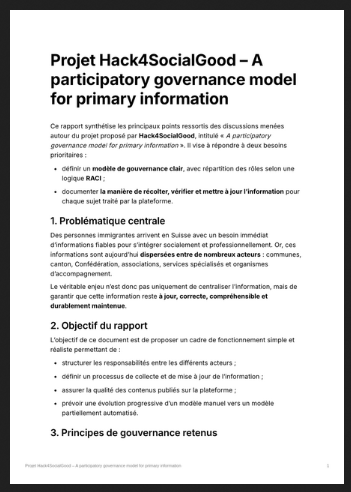
Project report (PDF)
HE-ARC
Navigation engine for immigrants
Moteur intelligent d’orientation personnalisée pour les primo-arrivants
Les migrants nouvellement arrivés sont confrontés à une grande quantité d’informations fragmentées, souvent difficiles à relier à leur situation personnelle. Cette complexité peut ralentir leur intégration et rendre l’accompagnement plus difficile pour les professionnels du terrain.Ce défi consiste à concevoir un prototype de moteur d’orientation personnalisée capable d’analyser le profil et les besoins d’un utilisateur afin de recommander des parcours d’intégration adaptés.
Le système devra prendre en compte plusieurs dimensions telles que la langue, le niveau de formation, la situation administrative, l’expérience professionnelle ou les objectifs d’intégration.Le hackathon explorera différentes approches technologiques, comme des modèles de recommandation explicables, des arbres décisionnels interactifs ou des assistants conversationnels. Une attention particulière sera portée à la transparence des recommandations et à l’accessibilité pour des publics à faible littératie numérique. L’objectif est de démontrer comment un outil numérique peut faciliter l’autonomisation des bénéficiaires et soutenir le travail des professionnels.
Offood Student Edition
Ensuring Every Student Has Time to Eat
Offood is an existing platform that allows users to reserve a table and pre-order their meals in restaurants, helping them avoid waiting and make better use of their lunch break. With Offood Student Edition, we would like to explore how this concept could be adapted specifically for students.
Students often have limited lunch breaks and face long queues in campus cafeterias or nearby restaurants, which can prevent them from accessing proper meals or force them to rush. The challenge is to prototype a dedicated “student workspace” experience within Offood that would allow students to easily access exclusive student menus, pre-order their meals, and pick them up without waiting.
We invite participants to imagine and prototype:
- the student user experience
- how students access and use this workspace
- how restaurants could provide dedicated student offers
- and how schools could be integrated into the system.
The goal is not to build a full production system, but to explore the concept, user flows, and overall experience, and help shape the future of Offood Student Edition.
Caritas Switzerland
Training Video Generator Using AI
Caritas Switzerland regularly trains its employees on topics ranging from HR policies to internal processes and compliance. Today, producing professional training videos requires expensive tools, significant production effort and manual translation - making it hard to keep content current and accessible across languages. With a multilingual workforce, Caritas needs a smarter, faster way to create consistent training content at scale. AI can change that.
Creating high-quality training videos today is time-consuming and resource-intensive. A standard 5-minute instructional video requires hours of scripting, recording, editing, and voice-over work - often repeated for each language. Existing off-the-shelf platforms offer limited API support and produce inconsistent results for longer-form content. Caritas needs an automated, code-driven approach that can reliably generate structured, professional training videos - complete with synchronized narration, on-screen visuals, and a consistent style - on demand and across multiple languages.
Goal of the Challenge: Build an internal tool that allows Caritas employees to automatically generate training videos on any topic - from HR onboarding to internal process documentation.
Key requirements:
- (1) Accepts a topic or short description as input and generates a complete 5-10 minute training video
- (2) Produces synchronized audio narration and on-screen visuals (e.g., slides, presenter avatar, animated text) with a consistent visual style
- (3) Generated in at least one language: EN / DE / FR / ES (multilingual output is a bonus)
- (4) Delivered as an automated pipeline application: a workflow that orchestrates multiple API calls (script generation, voice synthesis, video rendering) to produce longer-form videos end-to-end tool.
More details and resources in: https://github.com/Caritas-Schweiz/H4SG_Training_Video